
The Three Engines of Subscription Expansion
Lots of subscription businesses treat expansion as a single, tidy metric. Boards track it. CFOs model it. CROs target it. It sits neatly between churn and contraction.
Executives like the simplicity.
In truth expansion is three fundamentally different engines, each owned by different teams, each requiring different interventions, and each telling a different story about the health of the business.
For any enterprise subscription business, whether you sell software, research, data, intelligence, workflow solutions, or a mixed portfolio, this distinction matters more than most leaders realise.
Expansion deserves more precision from subscription leaders. It is tempting to measure it as one motion: revenue from existing customers grew, or it didn’t.
Underneath that number sit three drivers: The value customers actually experience, the commercial skill used to capture that value, and the pricing discipline applied to the contract base.
Those are not interchangeable, they are different mechanisms of the business.
A business leaning on the wrong engine may look strong right up to the moment a renewal cliff arrives, so it’s crucial that decsion-makers know which engine is doing the work.
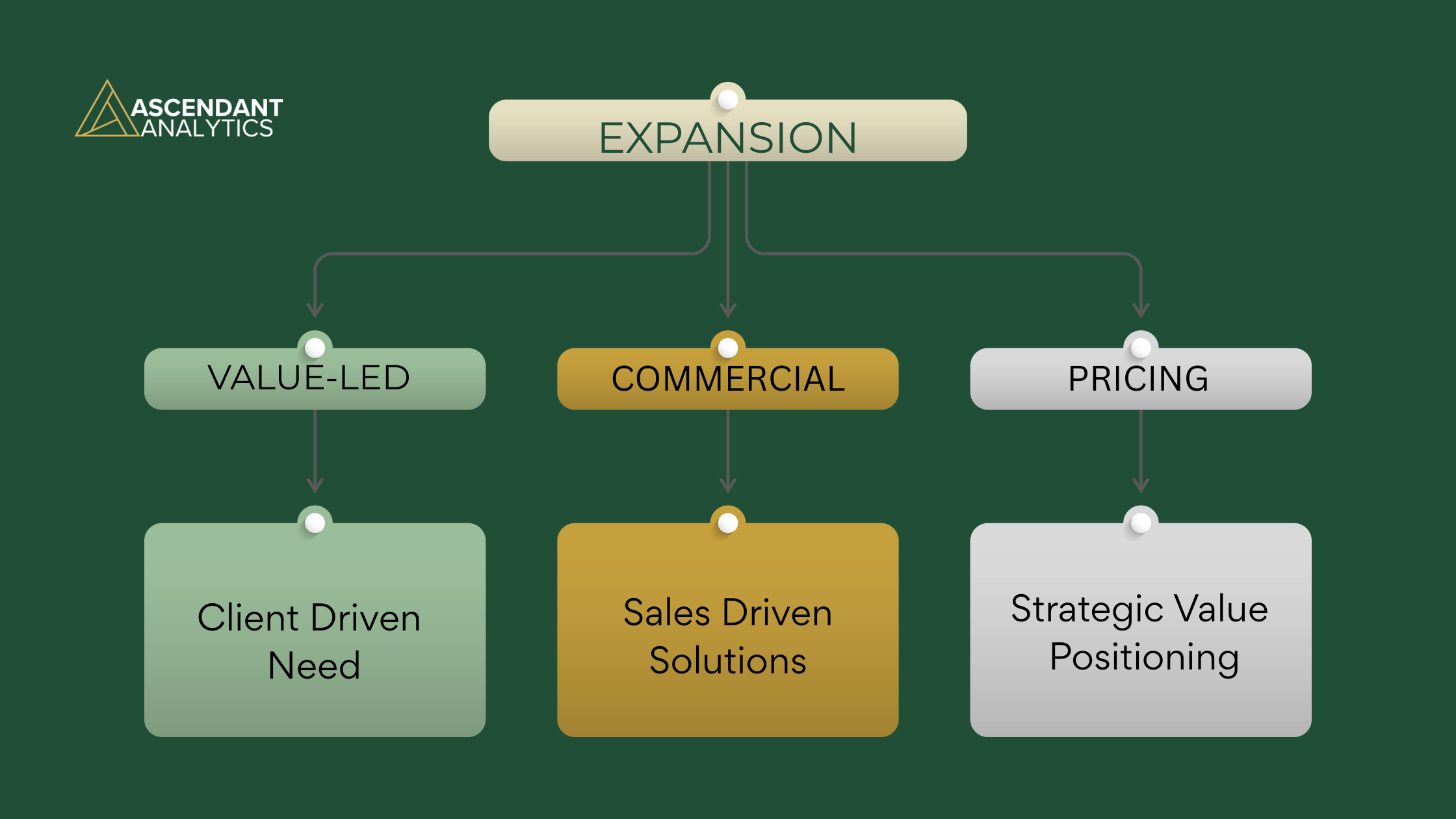
The Three Expansion Engines
1. Value-Led Expansion
Owned by Product, Research, Delivery, or Insight teams
Value-led expansion occurs when the customer’s needs expand because the product has become more relevant, more embedded, or more strategic.
This applies across every subscription model, here’s some examples:
In SaaS: teams adopt more capabilities or rely more heavily on the workflow
In research and data: clients expand into additional coverage areas or integrate the intelligence more deeply into their planning
In analytics platforms: more stakeholders begin relying on the insights
In managed services or hybrid models: the customer needs broader support or specialist modules
What matters is not how they expand, but why: the product is solving more of the customer’s problems.
Subscription leaders should see this engine as a signal of:
Strategic dependence
Strong product-market resonance
Increasing internal reach within the client
Value that is compounding
The interventions that support this engine are about substance:
Improving depth, accuracy, breadth, timeliness, or reliability
Ensuring the work influences senior decision-making
Removing friction from adoption
Strengthening the narrative around value delivered
This engine creates demand, it does not monetise it on its own.
That is the role of the next engine.
2. Commercial Expansion
Owned by Sales and Customer Success
Commercial expansion is the formal capture of value through cross sell, upsell, wider access, or multi-year reconfiguration.
This motion exists in every enterprise subscription business:
In SaaS: upgrades, add-ons, integrations, enterprise plans
In research: buying more domains, more user groups, more data
In analytics: expanding to new teams, dashboards, or support models
In workflow and specialised tools: adding modules, add-ons, or premium capabilities
In hybrid or managed services: extending scope, adding advisory layers, increasing hours
This engine depends on:
Account strategy
Stakeholder mapping
Negotiation
Packaging
Clear commercial stories
Confidence
This is an active, relationship-driven engine, it is powerful, but also lumpy, effort-heavy, and sensitive to incentives.
Subscription leaders should watch:
Discounting patterns
The proportion of expansion coming from negotiation versus organic demand
Segment-level variation
Renewal behaviour after expansion events
Commercial expansion is healthy when it formalises genuine value.
It becomes risky when it replaces it.
3. Pricing Expansion
Owned by Finance, Pricing, and Executive Leadership
Pricing expansion is the least glamorous and the most misunderstood engine, yet it could be considered the biggest contributor to long-term economics.
Every enterprise subscription business, regardless of product type, depends on structured, disciplined pricing interventions:
Inflationary adjustments
Harmonising legacy clients to modern pricing
Monetising new capabilities
Correcting historical underpricing
Reducing discount liabilities
Managing list price changes
Rationalising bundles and entitlements
Introducing tiered pricing logic
This is not opportunistic upselling, it is pricing strategy: consistent, programmatic, and deliberate.
Executed well, it:
Improves unit economics
Raises NRR
Reduces margin leakage
Builds long-term defensibility
Executed poorly, it:
Sparks churn
Damages trust
Overloads sales teams
Creates renewal cliffs
Pricing expansion is leadership discipline.
What You Should Track Instead
The number is not lying. It is simply telling you too little.
Expansion needs to be understood according to the three engines driving it:
1. Value-led expansion: evidence that customers are using more, relying more, or embedding more of the product.
2. Commercial expansion: revenue won through proactive cross sell and upsell.
3. Pricing expansion: uplift driven by structured pricing programmes.
This is not complexity for complexity’s sake, it is clarity for leadership’s sake.
Each engine has different owners, different interventions, different risks, different sustainability profiles and together they tell the full story.
The Questions Every Company Leader Should Ask
When leaders split expansion into three engines, better questions emerge:
Are we relying too much on pricing to hold up NRR?
Does expansion match genuine value adoption, or is it commercially engineered?
Which segments are expanding because they want more, and which expand only because we push it?
Are we strengthening long-term economics or masking underlying fragility?
If our commercial team vanished tomorrow, how much expansion would still occur?
If we paused pricing actions for a year, what would our book look like?
Questions like this turn expansion into a diagnostic tool, not a vanity metric.
Every enterprise subscription business, regardless of industry, runs on Value-Led, Commercial and Pricing Expansion.
Treat expansion as one number and you will miss the pattern, treat it as three engines and you will know exactly where to intervene.
The best businesses know why expansion is strong, how durable it is, and what it will take to protect it.